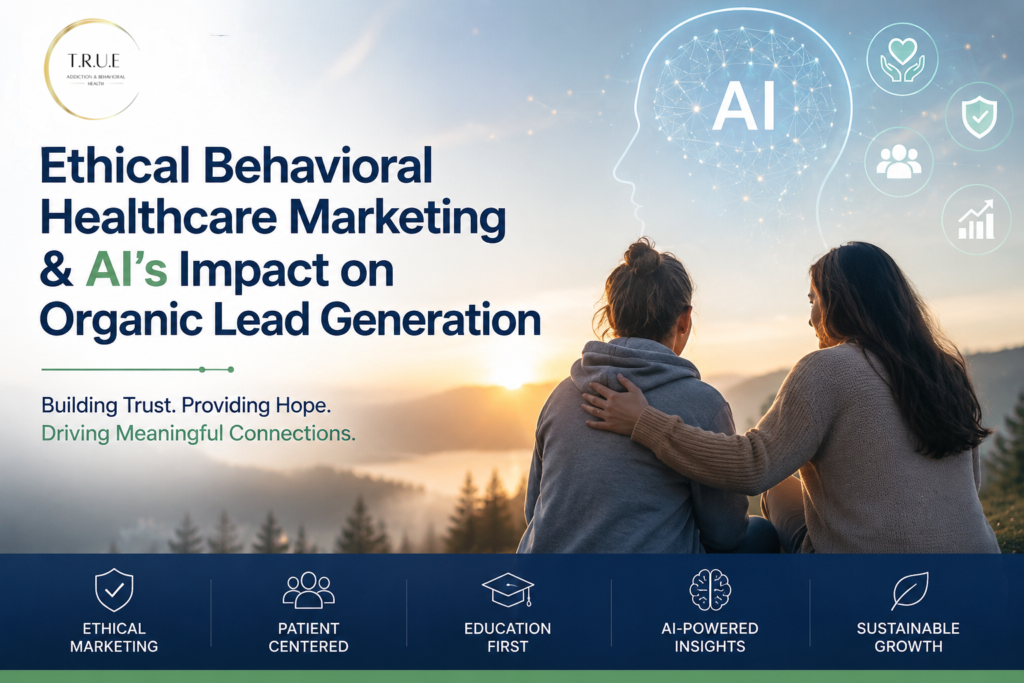
The Evolution of Behavioral Healthcare Marketing in the Age of Artificial Intelligence
The behavioral healthcare industry is experiencing one of the most significant transformations in its history. As artificial intelligence reshapes how individuals search for information, evaluate treatment options, and engage with healthcare providers, addiction treatment centers, mental health organizations, and behavioral healthcare networks must adapt to an entirely new digital landscape. At the same time, growing concerns about patient exploitation, misinformation, lead brokering, and deceptive advertising have elevated the importance of ethical marketing practices throughout the industry.
TRUE Addiction and Behavioral Health has emerged as a leader in demonstrating how ethical behavioral healthcare marketing and advanced artificial intelligence strategies can coexist to create sustainable, patient-centered growth. Rather than viewing marketing solely as a mechanism for admissions generation, TRUE recognizes that marketing serves as an extension of patient care. Every website visit, search query, article, video, and digital interaction represents an opportunity to educate, support, and guide individuals toward informed treatment decisions.
The convergence of ethical marketing principles and AI-driven organic lead generation is creating a new standard for behavioral healthcare organizations. Success is no longer measured exclusively by rankings, traffic volume, or advertising spend. Instead, organizations are increasingly evaluated by their ability to establish trust, demonstrate expertise, and provide meaningful value throughout the patient journey.
As search engines evolve into answer engines and artificial intelligence becomes integrated into every stage of online discovery, behavioral healthcare providers that prioritize transparency, education, and evidence-based communication are positioned to become the most trusted resources in their markets.
Defining TRUE’s Ethical Behavioral Healthcare Marketing Philosophy
Behavioral healthcare marketing carries unique responsibilities that do not exist in many other industries. Individuals seeking addiction treatment, mental health services, psychiatric care, or dual diagnosis support are often experiencing significant emotional distress. Families searching for help frequently feel overwhelmed, frightened, and uncertain about how to navigate treatment options.
TRUE Addiction and Behavioral Health recognizes that these circumstances require a fundamentally different approach to marketing.
Ethical behavioral healthcare marketing begins with a commitment to transparency. Prospective patients deserve honest information regarding treatment programs, clinical services, levels of care, provider credentials, insurance coverage, and expected outcomes. Marketing should never exaggerate success rates, make unrealistic promises, or create false expectations regarding recovery.
Transparency also extends to digital communications. Whether an individual is reading an article, interacting with an AI chatbot, watching a video, or completing an online assessment, the information presented should be accurate, verifiable, and clinically sound.
Equally important is the principle of patient dignity. Ethical marketing respects the autonomy of individuals seeking care. Rather than exploiting fear, shame, or vulnerability, TRUE’s approach focuses on empowerment through education. Patients are encouraged to make informed decisions based on reliable information rather than emotional pressure.
This philosophy aligns naturally with the broader goals of behavioral healthcare. Recovery and mental wellness are built on trust, honesty, and human connection. Marketing should reflect those same values.
Why Trust Has Become the Primary Currency of Behavioral Healthcare Marketing

In the early days of digital marketing, visibility was often enough to drive patient acquisition. Organizations that achieved strong search rankings or invested heavily in paid advertising frequently dominated admissions growth.
Today’s environment is dramatically different.
Consumers have become increasingly sophisticated. Individuals researching treatment options now compare providers, review clinical credentials, evaluate online reputation, read educational resources, and seek validation from multiple sources before making healthcare decisions.
Trust has become the defining factor in patient acquisition.
For behavioral healthcare organizations, trust is earned through consistency. It is built when educational content answers difficult questions honestly. It grows when provider expertise is visible throughout the patient journey. It strengthens when organizations prioritize education before conversion.
Artificial intelligence is accelerating this shift because AI-powered systems increasingly evaluate trust signals when determining which sources deserve visibility.
Search engines, AI assistants, and emerging answer engines seek to provide users with the most reliable information available. As a result, organizations that consistently demonstrate expertise, authority, and trustworthiness gain significant advantages in both traditional search results and AI-generated responses.
TRUE Addiction and Behavioral Health’s emphasis on educational leadership positions the organization to thrive within this trust-driven ecosystem.
Artificial Intelligence Is Reshaping How Patients Find Treatment
The way people search for behavioral healthcare information has fundamentally changed.
Historically, prospective patients entered short keywords into search engines, such as “drug rehab near me” or “depression treatment center.” Search engines responded by displaying a list of websites, and users conducted their own research by visiting multiple pages.
Today, AI-powered search experiences are creating a more conversational process.
Individuals increasingly ask detailed questions such as:
“How do I know if my anxiety requires professional treatment?”
“What are the signs that someone needs residential addiction treatment?”
“Can trauma therapy help with substance use disorders?”
“What happens during the first week of treatment?”
Artificial intelligence systems analyze these questions and generate comprehensive responses by synthesizing information from trusted sources.
This shift changes the rules of behavioral healthcare marketing.
Organizations can no longer focus exclusively on ranking for isolated keywords. They must become authoritative sources capable of answering complex patient questions with depth, accuracy, and empathy.
TRUE’s commitment to creating educational, evidence-based content aligns perfectly with this emerging search environment.
The Transition from SEO to Answer Engine Optimization
Traditional search engine optimization remains important, but the rise of artificial intelligence has introduced a new discipline known as Answer Engine Optimization (AEO).
SEO focuses on helping websites rank for specific search terms.
AEO focuses on ensuring that content can be easily understood, referenced, and surfaced by AI systems when users ask questions.
For behavioral healthcare organizations, this shift requires a more patient-centered content strategy.
Rather than creating pages solely designed to target phrases such as “addiction treatment” or “mental health center,” organizations must build comprehensive educational resources that address real concerns experienced by prospective patients and families.
Content should answer questions regarding treatment options, recovery expectations, clinical approaches, insurance considerations, family involvement, relapse prevention, trauma recovery, and mental health management.
When content genuinely helps users understand these topics, it becomes more valuable to both human audiences and artificial intelligence systems.
As AI-driven search continues expanding, organizations that invest in educational depth rather than keyword density will gain increasing visibility.
How AI Enhances Organic Lead Generation
Organic lead generation has always been one of the most valuable growth channels in behavioral healthcare because it attracts individuals actively seeking solutions.
Artificial intelligence is making organic lead generation more powerful than ever before.
AI-driven analytics platforms can identify emerging search trends, uncover content gaps, predict user behavior, and reveal patterns in patient research journeys. These insights allow organizations to create content that aligns more closely with actual patient needs.
Instead of relying on assumptions, behavioral healthcare marketers can use AI to understand what prospective patients are asking, when they are asking it, and how their questions evolve throughout the decision-making process.
This intelligence enables organizations like TRUE Addiction and Behavioral Health to develop highly relevant content ecosystems that attract qualified traffic organically.
When individuals discover valuable information during their search process, they are more likely to engage, trust the organization, and ultimately inquire about treatment services.
The result is a more efficient lead generation model that emphasizes education and relationship-building rather than interruption-based advertising.
Ethical AI Content Creation in Behavioral Healthcare
Artificial intelligence has dramatically increased the speed at which organizations can create content. Articles, FAQs, educational resources, social media content, and website copy can now be developed far more efficiently than ever before.
However, behavioral healthcare content requires a higher standard of responsibility.
Healthcare information directly influences treatment decisions and patient outcomes. As a result, AI-generated content should never be published without clinical oversight and professional review.
TRUE Addiction and Behavioral Health understands that technology should support expertise rather than replace it.
Artificial intelligence is most effective when used to assist research, identify trends, organize information, and improve efficiency. Human clinicians, subject matter experts, and healthcare professionals remain essential for ensuring accuracy, context, compliance, and ethical integrity.
This collaborative approach allows organizations to scale content production while maintaining the quality standards necessary for healthcare communications.
The future of behavioral healthcare content will not be purely human or purely artificial. It will be a carefully managed partnership between technology and expertise.
E-E-A-T and the Future of Healthcare Authority
Google’s framework for evaluating healthcare content centers on Experience, Expertise, Authoritativeness, and Trustworthiness, commonly known as E-E-A-T.
This framework has become increasingly influential in behavioral healthcare marketing because addiction treatment and mental health information fall within categories that can significantly impact a person’s well-being.
Artificial intelligence systems operate similarly.
When determining which sources deserve visibility, AI models prioritize signals associated with expertise and credibility.
Organizations that demonstrate clinical experience, employ qualified professionals, publish evidence-based content, and maintain transparent business practices are more likely to earn visibility across search engines and AI-powered platforms.
TRUE Addiction and Behavioral Health’s emphasis on educational leadership directly supports these objectives.
By consistently producing trustworthy content reviewed by qualified professionals, organizations establish the authority necessary to compete effectively in increasingly sophisticated search environments.
Conversational Search and Patient-Centered Content
Artificial intelligence has accelerated the rise of conversational search behavior.
Users no longer think in terms of isolated keywords. They ask questions the same way they would speak to a healthcare professional, family member, or trusted advisor.
This shift creates an opportunity for behavioral healthcare organizations to align content more closely with patient experiences.
Someone considering treatment for substance use disorder may not search for “residential addiction treatment.” Instead, they may ask, “Why can’t I stop drinking even when I want to?”
A person experiencing depression may search, “How do I know if I need professional help?”
These questions reveal emotional context, intent, and personal concerns that traditional keyword research often misses.
Organizations that understand conversational search can create content that speaks directly to the realities patients face. This approach improves both user engagement and AI visibility because it reflects authentic human communication.
Reputation Management in an AI-Driven Marketplace
Reputation management has become one of the most important components of organic lead generation.
Artificial intelligence systems increasingly analyze reputation signals when determining which organizations deserve visibility. Online reviews, provider credentials, media mentions, educational content, community engagement, and patient feedback all contribute to an organization’s digital authority.
For behavioral healthcare providers, reputation extends far beyond star ratings.
Trust is established through transparency, responsiveness, professionalism, and educational leadership.
TRUE Addiction and Behavioral Health’s ethical marketing philosophy reinforces reputation development by prioritizing patient education and meaningful engagement.
Organizations that consistently deliver value earn stronger community trust, generate more positive patient experiences, and strengthen the digital signals that influence AI-driven discovery.
As AI becomes more sophisticated, reputation will become even more closely tied to organic visibility.
Personalization Without Exploitation
Artificial intelligence allows marketers to personalize experiences at unprecedented levels.
Content recommendations, educational pathways, website experiences, and informational resources can all be tailored to individual user needs.
In behavioral healthcare, however, personalization must be approached carefully.
Patients seeking treatment are often vulnerable. Ethical organizations recognize the difference between helpful personalization and manipulative targeting.
TRUE Addiction and Behavioral Health advocates for personalization that enhances education rather than pressures decision-making.
The goal is to help individuals find relevant information more efficiently, not to exploit emotional vulnerabilities for admissions growth.
Responsible personalization improves patient experiences while maintaining the dignity and autonomy essential to ethical healthcare marketing.
The Future of Organic Lead Generation for Behavioral Healthcare Organizations
The future of behavioral healthcare marketing will be defined by authority, trust, education, and responsible technology adoption.
Organizations that rely solely on paid advertising may find themselves increasingly vulnerable as consumer expectations evolve and AI-powered search becomes more influential.
Conversely, organizations that invest in educational ecosystems will benefit from compounding organic visibility.
High-quality articles, clinician interviews, podcasts, videos, research summaries, recovery resources, assessment tools, and thought leadership content create long-term assets that continue generating value over time.
AI enhances the effectiveness of these assets by improving discoverability, personalization, and content optimization.
The organizations that succeed will be those that view marketing not as a promotional activity but as an educational mission.
TRUE Addiction and Behavioral Health exemplifies this philosophy by focusing on patient needs first and leveraging technology to expand access to trustworthy information.
Conclusion
TRUE Addiction and Behavioral Health’s approach to ethical behavioral healthcare marketing reflects the future of patient acquisition in an AI-driven world. As artificial intelligence transforms how people search for information and evaluate treatment providers, trust has become the most important competitive advantage a behavioral healthcare organization can possess.
Ethical marketing, rooted in transparency, education, empathy, and evidence-based communication, aligns naturally with the priorities of modern search engines and AI systems. Organizations that provide genuine value to patients are increasingly rewarded with greater visibility, stronger engagement, and higher-quality organic leads.
Artificial intelligence is not replacing human expertise. Instead, it is amplifying the importance of credibility, authority, and meaningful content. Behavioral healthcare providers that combine advanced AI capabilities with unwavering ethical standards will be best positioned to thrive in the years ahead.
For TRUE Addiction and Behavioral Health, the future of marketing is not about generating more impressions or attracting more clicks. It is about becoming the most trusted source of information for individuals and families seeking hope, healing, and recovery. Through ethical leadership and responsible innovation, TRUE is helping define a new standard for behavioral healthcare marketing—one where technology serves humanity, education drives engagement, and trust remains the foundation of sustainable growth.
Frequently Asked Questions About Ethical Behavioral Healthcare Marketing and AI
What is ethical behavioral healthcare marketing?
Ethical behavioral healthcare marketing is the practice of promoting addiction treatment, mental health services, and behavioral healthcare programs through transparent, accurate, and patient-centered communications. It prioritizes education, informed decision-making, and respect for patient autonomy while avoiding misleading claims, fear-based messaging, or unethical lead-generation tactics.
Why is ethical marketing important in addiction and behavioral health?
Individuals seeking addiction treatment or mental health services are often in vulnerable situations. Ethical marketing ensures that patients and families receive trustworthy information that helps them make informed healthcare decisions. It also protects organizations from reputational damage while building long-term trust within the communities they serve.
How does TRUE Addiction and Behavioral Health approach ethical marketing?
TRUE Addiction and Behavioral Health focuses on transparency, clinical accuracy, patient education, and evidence-based communication. Rather than prioritizing admissions at any cost, TRUE emphasizes providing valuable resources that help prospective patients understand treatment options, recovery pathways, and behavioral healthcare services before making a decision.
How is artificial intelligence changing behavioral healthcare marketing?
Artificial intelligence is transforming how individuals search for information, discover treatment providers, and evaluate healthcare options. AI-powered search engines and conversational platforms now provide direct answers to patient questions, making high-quality educational content more important than ever. Organizations that demonstrate expertise, authority, and trustworthiness are more likely to be recommended by AI-driven platforms.
What is the difference between traditional SEO and AI-driven search?
Traditional SEO focuses on optimizing webpages to rank for specific keywords in search engines. AI-driven search prioritizes answering user questions directly and providing personalized responses based on trusted information sources. As a result, behavioral healthcare organizations must focus on creating comprehensive, authoritative content that addresses real patient concerns rather than simply targeting keywords.
What is Answer Engine Optimization (AEO)?
Answer Engine Optimization (AEO) is the process of structuring content so that artificial intelligence platforms, voice assistants, and search engines can easily understand and present answers to user questions. For behavioral healthcare organizations, AEO involves creating educational content that addresses topics such as addiction treatment, mental health disorders, recovery, insurance coverage, and family support in a clear and accessible format.
Can AI-generated content be used in behavioral healthcare marketing?
Yes, but it should always be reviewed by qualified professionals. AI can help streamline content development, identify trending topics, and improve operational efficiency. However, healthcare content must be clinically accurate, ethically sound, and compliant with industry regulations. Human oversight remains essential to ensure content quality and patient safety.
How does AI improve organic lead generation?
AI helps organizations identify patient needs, uncover search trends, analyze user behavior, and optimize content strategies. These insights allow behavioral healthcare providers to create highly relevant resources that attract qualified prospects through organic search. By better understanding patient intent, organizations can develop content that drives engagement and builds trust throughout the treatment journey.
What role does trust play in behavioral healthcare marketing?
Trust is the foundation of successful behavioral healthcare marketing. Patients and families are more likely to engage with providers that demonstrate expertise, transparency, and compassion. Search engines and AI systems also prioritize trustworthy content, making credibility a critical factor in both patient acquisition and online visibility.
How does Google evaluate behavioral healthcare content?
Google evaluates behavioral healthcare content using its Experience, Expertise, Authoritativeness, and Trustworthiness (E-E-A-T) framework. Websites that feature clinician-reviewed content, credible sources, transparent information, and demonstrated expertise are more likely to achieve strong search visibility and maintain long-term organic growth.
Why is content marketing important for addiction treatment centers?
Content marketing allows addiction treatment centers to educate prospective patients before they enter treatment. High-quality articles, videos, guides, and educational resources help individuals understand addiction, recovery, treatment options, and mental health conditions. This educational approach builds trust and supports informed decision-making.
How can behavioral healthcare organizations prepare for AI-powered search?
Organizations should focus on creating authoritative, patient-centered content that directly answers common questions. They should invest in clinician-reviewed educational resources, maintain strong online reputations, optimize for conversational search queries, and ensure all digital content aligns with ethical healthcare marketing standards.
Does AI replace human marketers in behavioral healthcare?
No. AI enhances marketing capabilities but does not replace human expertise. Successful behavioral healthcare marketing requires empathy, clinical understanding, ethical judgment, and strategic oversight. AI serves as a powerful tool that supports professionals rather than replacing them.
What are the benefits of organic lead generation compared to paid advertising?
Organic lead generation creates sustainable growth by attracting individuals actively searching for behavioral healthcare information. Unlike paid advertising, organic visibility continues generating value over time through educational content, thought leadership, and search authority. Organic leads are often more informed, more engaged, and more likely to trust the organization they contact.
What does the future of behavioral healthcare marketing look like?
The future will be driven by trust, education, personalization, and responsible AI implementation. Organizations that prioritize ethical practices, publish high-quality educational content, and leverage AI responsibly will be best positioned to attract patients, strengthen their reputations, and achieve sustainable long-term growth in an increasingly competitive digital environment.
Sources and Resources

The following sources, frameworks, and industry resources informed the concepts discussed throughout this article regarding ethical behavioral healthcare marketing, artificial intelligence, organic lead generation, and healthcare search visibility.
Google Search Central
Google’s Search Quality Evaluator Guidelines provide foundational guidance regarding Experience, Expertise, Authoritativeness, and Trustworthiness (E-E-A-T), which are critical evaluation factors for healthcare and behavioral health websites.
Resource:
https://developers.google.com/search/docs
Google Search Quality Evaluator Guidelines
Google’s Quality Rater Guidelines outline how healthcare content is evaluated within “Your Money or Your Life” (YMYL) categories, including addiction treatment and mental health services.
Substance Abuse and Mental Health Services Administration (SAMHSA)
SAMHSA provides evidence-based guidance, treatment resources, behavioral health statistics, and best practices for addiction and mental healthcare providers.
Resource:
https://www.samhsa.gov
National Institute on Drug Abuse (NIDA)
NIDA offers extensive research on addiction science, treatment effectiveness, recovery outcomes, and evidence-based interventions.
Resource:
https://nida.nih.gov
National Institute of Mental Health (NIMH)
NIMH serves as one of the leading sources of research and education regarding mental health disorders, treatments, and patient care.
Resource:
https://www.nimh.nih.gov
American Psychological Association (APA)
The APA publishes clinical guidance, ethical standards, behavioral health research, and professional best practices relevant to mental healthcare organizations.
Resource:
https://www.apa.org
American Society of Addiction Medicine (ASAM)
ASAM provides clinical guidelines and evidence-based standards for addiction treatment, recovery management, and patient-centered care.
Resource:
https://www.asam.org
Joint Commission Behavioral Health Standards
The Joint Commission establishes accreditation standards and quality benchmarks for behavioral healthcare organizations.
Resource:
https://www.jointcommission.org
Commission on Accreditation of Rehabilitation Facilities (CARF)
CARF provides internationally recognized standards focused on quality improvement, patient outcomes, and behavioral healthcare excellence.
Resource:
https://www.carf.org
Healthcare Internet Ethics and Advertising Guidance
Behavioral healthcare organizations should maintain compliance with healthcare advertising regulations, privacy requirements, and ethical communication standards established by federal and state agencies.
Resources:
- Federal Trade Commission (FTC): https://www.ftc.gov
- U.S. Department of Health and Human Services (HHS): https://www.hhs.gov
- HIPAA Privacy Rule: https://www.hhs.gov/hipaa
AI and Search Resources
Google AI and Search
Google’s evolving AI-powered search experiences, Search Generative Experience (SGE), and AI Overviews continue to shape how healthcare content is discovered and consumed.
Resource:
https://blog.google/products/search
OpenAI Research and AI Safety
OpenAI publishes research regarding responsible AI development, model behavior, and practical applications of artificial intelligence.
Resource:
https://openai.com/research
Microsoft AI and Search Innovation
Microsoft provides insights into AI-powered search experiences, conversational search, and large language model integration.
Resource:
https://blogs.microsoft.com/ai
Recommended Reading for Behavioral Healthcare Executives
For behavioral healthcare leaders seeking to strengthen organic lead generation strategies, the following topics warrant ongoing study:
- Ethical Healthcare Marketing
- Behavioral Healthcare SEO
- Answer Engine Optimization (AEO)
- AI-Powered Search and Discovery
- E-E-A-T and YMYL Content Standards
- Patient Experience and Digital Engagement
- Online Reputation Management
- Healthcare Consumer Behavior
- Recovery-Focused Content Marketing
- Behavioral Healthcare Compliance and Privacy
About TRUE Addiction and Behavioral Health
TRUE Addiction and Behavioral Health believes ethical marketing should function as an extension of patient care. By combining evidence-based communication, patient-centered education, advanced AI technologies, and transparent business practices, TRUE is committed to helping individuals and families access reliable information while supporting informed treatment decisions.
As artificial intelligence continues to reshape healthcare discovery, organizations that prioritize trust, expertise, and ethical responsibility will be best positioned to serve patients while achieving sustainable organic growth.